Call:+1 909 509 4388
 24/7 Emergency Service
 info@intcorecycling.com
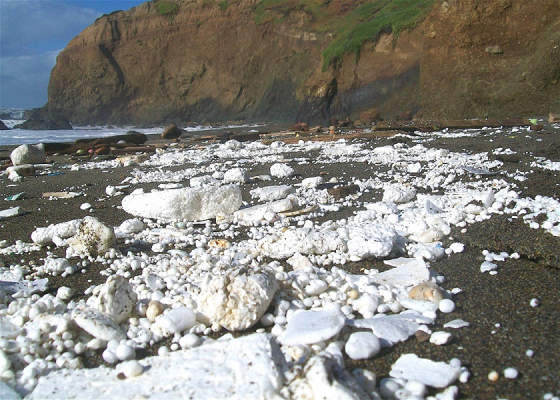
Call:+1 909 509 438824/7 Emergency Service info@intcorecycling.comThe Anacostia River in Washington, D.C. flows through Maryland and empties into the Potomac River. In December 2011, before D.C. placed an effective ban on foam food container products, foam products made up 37% of all waste collected from the river by the Anacostia Watershed Society. In 2016, foam only accounted for 7% of waste collection, down from 15% in 2015, and in 2020 this proportion will drop again by half to 3%. In the United States, only 10% of plastic is recycled, of which the foam recycling rate is less than 1%. There are basically two reasons for such a low recycling rate: Consumers and related industries have imperfect recycling practices, and substandard technology limits foam recycling.
From my point of view, I think the former should be the main reason. Although the current recycling technology is not so perfect, there are many recycling methods. The main reason is that the relevant industries and departments have a weak awareness of foam recycling and have not studied the method of foam recycling. In other words, they have not realized the urgency of the task of environmental protection and the importance of the foam recycling project. In terms of foam recycling, what individuals should do is just to do a good job of sorting garbage. The main thing is what related industries and departments should do. Sometimes maybe it’s not that they don’t want to do it while they don’t understand what methods are available for foam recycling. Today, Rebirth of Foam will introduce you to two types of foam recycling methods that are very common nowadays, chemical recycling method【1】 and mechanical recycling method【2】.

【1】
【2】
Chemical recycling method【3】
Chemical recycling, also known as feedstock recycling refers to techniques used to break down foam polymers into their constituent monomers, which in turn can be used again in refineries, or petrochemical and chemical production. Such technologies turn foam into basic chemicals for use. Chemical recycling technologies satisfy the general principle of foam recycling, Most widely used chemical recycling processes include de-polymerisation, thermal cracking, hydrogenation, and gasification. In principle, cleavage of the polymer chains results in chemical products of lower molecular weight distribution or even in the original intermediates (monomers) which can be used for another complete cycle of polymerization. The more commonly used of these four methods are the first two: de-polymerisation, and thermal cracking. The company, Covestro AG, in Gemany is using this method for foam recycling
1 De-polymerisation
The use of de-polymerization is on the cutting edge. By using ionic liquids or a terpene hydrocarbon such as d-limonene, an orange byproduct, foam can be degraded. The resulting polymer solution can then be separated from the solvent and be mixed with other additives and materials. This has a large advantage over re-melting as its process produces 30% less CO2 emissions and consumes 20% less energy while achieving the same goal. The disadvantage of chemical de-polymerisation is that it is almost completely restricted to the recycling of condensation of polymers and it is no use for the decomposition of most additional polymers which are the main components of the foam waste streams.
2 Thermal cracking
The thermal recycling of post-consumer foam wastes has been studied most extensively for high-value petrochemical or fuel feedstock. The technique is based on a fluidized bed, in which the foam is fed in the solid state, and sand is used for helping fluidization. Pyrolysis is the thermal degradation of organic waste in the absence of oxygen to produce carbonaceous char, oil, and combustible gases. Among the advantages of the stand-alone process are ease of operation and relatively low investment, recyclers, and landfill operation to own and operate them as part of their waste management practices. The disadvantage in these systems is in the removal of the many minor products formed from the pyrolysis reactions.
3 Advantages
Chemical recycling encompasses a number of technologies, which can be attractive recycling solutions for foam not best suited to mechanical recycling, e.g. mixed packaging waste. The chemical recycling method can recover foam containing impurities and stains.
4 Disadvantages
Chemical recycling is more costly compared to mechanical recycling, and less energetically favorable as the polymer has to be depolymerized and then re-polymerized. A large amount of solvent loss: a variety of solvent/non-solvent mixtures, such as butyl acetate/n-heptane, p-xylene/n-heptane, etc. These technologies are difficult to commercialize because all solvents cannot be recovered, they have a physical and chemical affinity with polymers, and the operating cost of the solvent recovery system is high, which is close to the production of virgin foam.
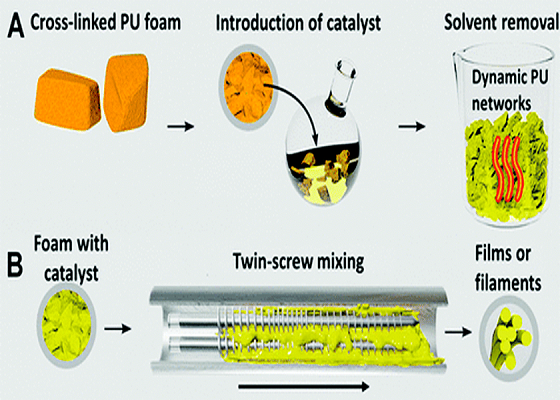
【3】
Mechanical recycling method
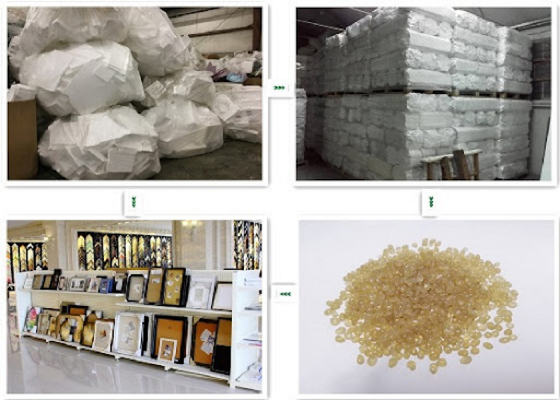
Mechanical recycling of foam refers to processes that involve the reprocessing of foam waste by melting, shredding, or granulation. This process is performed through heating to melt and reduce the volume of foam as required. The maximum temperatures in the recycling section vary depending on foam type from 130-260°C. A key criterion for successful mechanical recycling is the availability of homogeneous waste streams of known characteristics. There are two main types of mechanical recycling methods: foam compactor and foam densifier. The company in the US, Intco Recycling GREENMAX, is using this method for foam recycling.
1 Foam compactor【4】
This method is mainly to compress the foam collected during the foam recycling process through a machine, foam compactor, using the pressure of a screw or a hydraulic press. The whole process does not involve heating (the heat generated by the machine itself in the working process is not counted) Then use these compressed foams for granulation to obtain plastic particles and then use these plastic particles to make new plastic products. The main work process of foam compactor is probably like this: First put the foam in the crushing chamber of the machine, the foam is cut into small pieces of suitable size and then extruded through the screw. The working principle of this machine is not complicated, but there may be some of its parameters that require us to manually adjust and control.
2 Foam densifier【5】
This machine is also remanufactured by compressing foam and then making plastic particles, but the working principle is slightly different. The foam is also broken into small pieces through the crushing chamber and then melted by the hot melt device (this process does not change the molecular structure of the foam, so we also call it the physical recycling method.) These melted foams are like thick jelly that is squeezed out after passing through a screen. Be careful before these melted foams cool because their temperature is quite high. Compared with the foam compactor, the operation of the foam densifier is simpler. We do not need to adjust its parameters and only need to preheat the machine and then it can be used. However, the foam densifier will have a little smell in the process of foam recycling while the foam compactor has almost no smell. Another point is that the compression ratio of the foam densifier will be greater than that of the foam compactor. If the compressed foam is to be sold later, then the smaller the volume of the foam, the less the cost of transportation will be.
3 Advantages
Compared with the chemical recycling method, the mechanical recycling method saves more energy. It costs less in the foam recycling process. It is more suitable for large-scale recycling. Moreover, the mechanical recycling method is easier to operate. It is not as complicated as the chemical recycling method.
4 Disadvantages
Degradation of the material due to repeated processing, resulting in a loss of properties such as appearance, chemical resistance, processibility, and mechanical characteristics; The product obtained after recycling may not be as pure as the material obtained by the chemical recycling method.
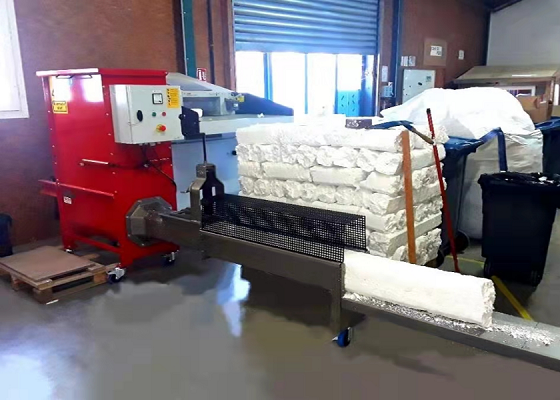
【4】
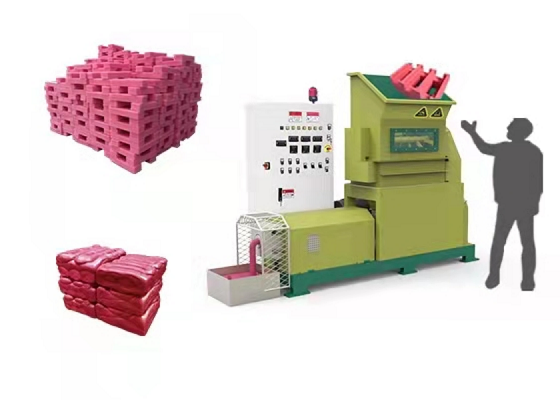
【5】
If you want to know more about recycling machines, you can refer to the article about foam recycling machines posted by Rebirth of Foam. In that article, we gave you a detailed introduction to the common foam recycling machines on the market.