Foam recycling has now attracted the attention of governments and related departments around the world. The phenomenon of foam pollution has become more and more serious in today's society. If we don't do anything, by 2025 we will have waste foam everywhere on our land and there will be more plastic foam in the ocean than fish! Therefore, the issue of foam recycling should be paid attention to by everyone. The action of foam recycling should also be carried out as soon as possible. Today,
Rebirth of Foam (ROF) will introduce the relevant content of foam recycling to you from two aspects: Why
foam recycling is necessary and what machines are commonly used during foam recycling.

Why foam recycling is necessary
First of all, from an ecological point of view, foam is a non-degradable waste, which affects the aesthetics of the environment, and foam fragments will enter the ecosystem as animals eat, and then affect humans. EPS(a kind of foam)can be consumed by fishes once it breaks down in the ocean. Marine animals higher up the food chain could eat the fishes that have consumed EPS, thus concentrating the contaminant. It could be a potential health hazard for us humans who are on top of the food chain considering that styrene, the plastic monomer used in manufacturing EPS has been classified by the US National Institutes of Health (NIH) and the International Agency for Research on Cancer (IARC) as a possible human carcinogen.
Secondly, countries around the world are advocating for foam recycling. Waste (Scotland) Regulations were passed long ago by the Scottish Parliament on 9 May 2012 to better recycle foam. One of the policies states that recyclable waste is not allowed to be incinerated or landfilled, there is no doubt that foam is 100% recyclable waste. Local authorities will provide basic recycling services to all households by 1 January 2014. Coincidentally, Wales became the only part of the UK to set statutory waste and recycling targets in December 2010, by passing the Waste (Wales) Measure. Under this law, every local authority in Wales must meet recycling targets, including foam recycling, which rise gradually to 70% by 2025 or face fines.
Finally, foam recycling equals resource conservation. According to Rebirth of Foam (ROF), adopting foam recycling would create a financial boon for New York City. The recycling markets for foam are much more profitable than steel cans, glass ,and cardboard materials. Using the city's waste estimates, a 100% recycling program would generate more than $9 million in annual revenue, and millions more would be saved in landfill avoidance costs. Conversely, a proposal to ban foam products would impose undue financial burdens on small businesses. According to a report by the Berkley Research Group, foam alternatives would add costs of more than $51 million annually for consumers, businesses and, New York City. Banning the use of foam is not feasible for some industries, so we can only solve it from the level of foam recycling. Moreover, landfill and incineration not only violate the concept of environmental protection, but also require high labor costs, and waste foam, a reusable resource, is wasted. To sum up, we must do foam recycling for several reasons!

What machine is used for foam recycling
Before understanding the recycling machine, we must first understand why we should use the recycling machine. First of all, there are mechanical recycling methods and chemical recycling methods for foam recycling. If you want to learn more about these two recycling methods, you can visit a previous article of Rebirth of Foam (ROF). (https://www.foam-recycling.com/chemical-recycling-vs-mechanical-recycling-of-foam-waste.html) For large-scale recycling of foam, we prefer mechanical recycling because this recycling method requires lower costs. Due to the large volume of foam and lightweight per unit volume, about 98% of them are air and occupy a large area. Therefore, high transportation costs are required in the recycling process. The function of the recycling machine is to reduce the volume of the foam as much as possible to save transportation costs. This is also an essential step in the foam recycling process.
Cold Compactor
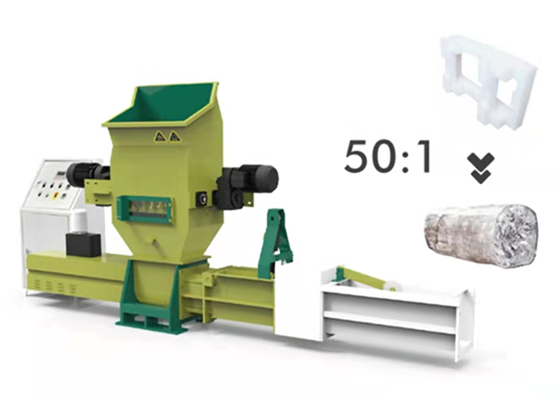
The cold compactor is a kind of foam recycling machine which can be used in compressing many kinds of waste foam into blocks by rotating screw pressure without heating. The cold compactor is suitable for recycling EPS foam lunch boxes, fish boxes, and packaging, XPS foam insulation boards, EPP foam auto parts, etc. Fishing, catering, supermarkets, construction, animal and plant breeding, sports equipment industry, and even the medical industry can use cold compactors for foam recycling. Equipped with the screw and automatic hydraulic system, the waste foam can be pre-crushed in the storage bin and then compacted into dense and uniform blocks with a volume reduction ratio of 50:1, greatly reducing the volume of waste foam, therefore saving storage and transportation costs.

When it comes to wet EPS foam fish boxes for fishing and EPP foam parts for the automotive industry, it has to be said that a mechanical company in the United States has innovated and manufactured two upgraded versions of cold compactors. One is a cold compactor suitable for compressing EPS foam fish boxes. This machine is made of stainless steel to ensure long-term work in a humid environment without rusting. The other is for EPP foam and EPE foam compression. Because EPP foam has high hardness and EPE foam has strong toughness, the surface of the compressed foam block is not easy to be compressed by the traditional cold compactor. Therefore, the company added a heat-melting ring based on the original cold compactor to heat the surface of the dense foam block to melt the surface foam, making the compressed foam more compact and not easy to loosen.
Melting Machine
The melting machine is a foam recycling machine equipped with screw melting technology, specialized in reducing the volume of waste foam by crushing, hot melting, and extrusion molding. When the melting machine starts, throw the waste foam into the machine hopper where it is crushed into small pieces, then drop into the screw part where the crushed foam pieces will be pushed out and then melted by heating parts. Finally, the foam waste will become the hot melted ingots with a density of 90:1, greatly saving transportation and storage costs. The melting machine can process almost all kinds of waste foams (excluding PU foam) on the market, and this machine has better performance when dealing with EPP foam and EPE foam, so it is favored by EPE foam-related industries. For example, mesh protective sleeves for fruits and vegetables, high elastic protective packaging for certain fragile products.
Foam Crusher
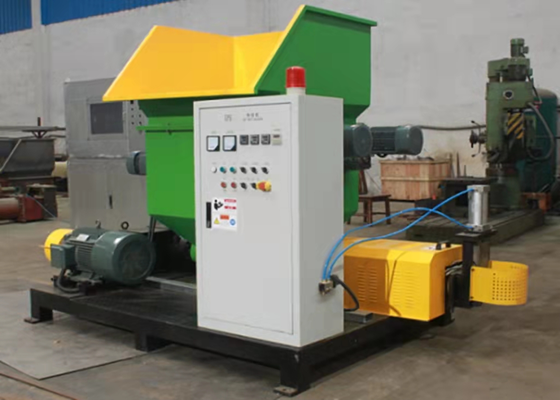
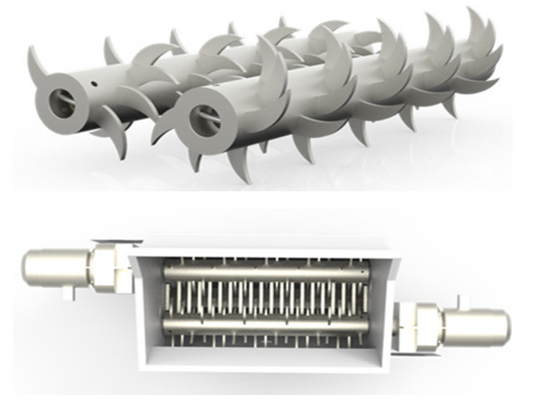
The foam crusher can smash the waste plastic material into granules and beads. There are two kinds of common crushers, one is a normal foam crusher and the other is foam beads crusher, normal foam crusher can crush foam into small pieces and foam beads crusher can crush foam into foam beads. An efficient heavy crusher driven by two powerful motors is able to break foams of all sizes and densities. The sharp cutter can shred all kinds of foam, especially PE foam, EPS foam, into 20-50 mm size small pieces. The shredded foam can be used to make new plastic products.

SWD
To be precise, SWD does not just refer to a machine. It is a system that is mainly used in the catering industry for cleaning, crushing, and recycling. Because the foam lunch boxes in the catering industry are very dirty, they cannot be directly recycled. Dirty foam disposable tableware is washed and then broken for foam recycling.
How to choose a foam recycling machine?
First of all, we have to consider our budget and what grade of machines we need from reality. There are many brands of foam recycling machines on the market, and the prices are also different. You can choose according to your budget. Secondly, you can choose according to your industry and the type of foam to be processed. The above has roughly introduced which type of foam is suitable for which recycling machine. If you have any questions, you are welcome to consult Rebirth of Foam(ROF) at any time. Finally, you can also choose machines with different powers according to the amount of waste foam produced by your factory. Each machine has different powers. You can choose according to your needs.
After the introduction of Rebirth of Foam (ROF), do you also think that foam recycling is not as difficult as you think? Foam recycling can not only protect the environment we depend on, but also contribute to resource cycling and economic development.
 Call:+1 909 509 4388
 24/7 Emergency Service
 info@intcorecycling.com